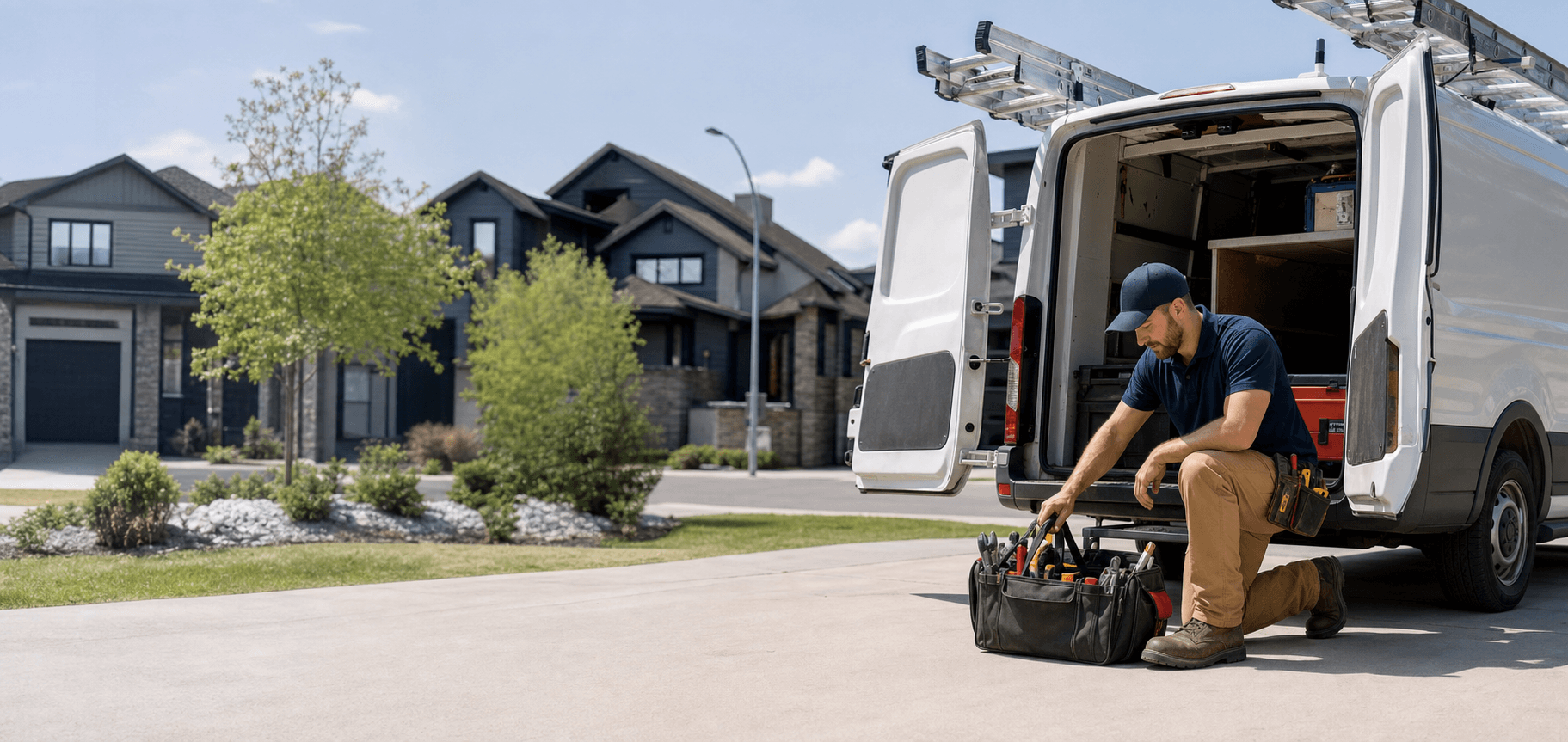
Calgary's 5,000–5,500 heating degree days per year make attic insulation one of the most cost-effective home improvements available. Most Calgary homes built before 2000 have attic insulation of R-20 to R-32 — below the current Alberta Building Code minimum of R-50 for Climate Zone 7. Upgrading is straightforward in most cases, but choosing the right product and doing the air sealing first determines whether the investment achieves its potential savings.
Calgary's Climate Zone 7 requirements
Alberta Building Code (2019 edition) adopted Climate Zone 7 designation, which reflects Calgary's severe heating climate. The minimum R-value requirements for new construction are:
| Location | Minimum R-value (Climate Zone 7) | Recommended (NECB) |
|---|---|---|
| Attic ceiling (above heated space) | R-50 | R-50 to R-60 |
| Exterior walls (above grade) | R-22 effective (whole-wall, including framing) | R-28 to R-36 effective |
| Basement walls (below grade) | R-17 effective | R-20 to R-24 |
| Basement slab on grade | R-12 | R-16 to R-20 |
| Crawl space walls | R-20 effective | R-24 |
For existing homes in Calgary, these are targets rather than code requirements — existing homes are not required to meet new construction standards unless a major renovation triggers a permit. However, upgrading to R-50 attic insulation is typically the highest return-on-investment insulation upgrade in a Calgary home.
Blown-in vs. batt: which is better for Calgary attics
| Property | Blown-in fibreglass | Blown-in cellulose | Batt (fibreglass) |
|---|---|---|---|
| R-value per inch | R-2.5 to R-3.2 | R-3.2 to R-3.8 | R-3.1 to R-3.7 |
| Coverage quality | Excellent — fills gaps | Excellent — fills gaps | Poor — leaves gaps around obstructions |
| Calgary attic suitability | Excellent | Excellent | Acceptable for initial install; poor for top-up |
| Air infiltration resistance | Good | Best — denser, settles into gaps | Poor — convective loops within batt |
| Moisture absorption risk | Low — does not absorb water | Medium — absorbs moisture; can compact if wet | Low (if dry-installed) |
| Settle over time | Minimal | Settles 15–20% in first year | Compresses under weight |
| Cost (materials only) | Moderate | Low | Low |
For Calgary attics, blown-in fibreglass or cellulose is the correct choice for insulation top-ups. Blown-in fills around every obstruction without cutting or fitting, maintains contact with the framing everywhere, and is faster to install. The choice between fibreglass and cellulose is largely cost-driven; cellulose (recycled paper) is denser and settles less over time, while fibreglass does not absorb moisture (important in Calgary attics that see condensation during cold snaps).
Why air sealing should come first
In Calgary homes, air infiltration through unsealed penetrations in the attic floor (the ceiling plane) can account for 30–50% of heat loss in a poorly sealed attic — more than the conductive loss through the insulation itself. Sealing these penetrations before insulating gives insulation the environment it needs to work:
Common Calgary attic penetrations to seal
- Pot lights (recessed lights) — non-IC-rated pot lights are the largest single air leakage source in Calgary attics, with some units leaking as much air as a 150mm diameter hole. Replace with IC-rated air-tight units, or install sheet-metal caps sealed with acoustic sealant from the attic side.
- Electrical boxes for ceiling outlets and switches — standard plastic electrical boxes are not sealed; spray foam around the box from the attic side.
- Partition walls — in Calgary homes with attic-accessible ceilings, the top plates of interior partition walls are often open, allowing warm air from the wall cavity to enter the attic. Seal with acoustic sealant or spray foam.
- Plumbing vents — the gap around PVC pipes passing through the ceiling plane; seal with fire-rated acoustic sealant (not spray foam, which may not meet fire separation requirements).
- Attic hatch — a common R-0 location; install an insulated cover box on the attic side. An uninsulated attic hatch is equivalent to leaving a window open in the ceiling.
Attic ventilation: soffit and ridge vents matter in Calgary
Proper attic ventilation is essential in Calgary to prevent two problems:
- Ice dams — in Calgary's climate, warm attic air (from heat escaping below) melts snow on the roof. The meltwater runs to the cold eaves and refreezes, forming ice dams that back water under shingles. Proper ventilation keeps the attic cold enough that the entire roof deck stays at outdoor temperature, preventing differential melting.
- Condensation — in very cold Calgary conditions (-30°C+), moisture from the house that enters the attic can condense and frost on the underside of the roof sheathing. Ventilation exhausts this moisture before it accumulates.
When adding insulation, ensure existing baffles (rafter chutes from soffit to attic space) are not buried. If they are missing, install proper ventilation baffles before adding blown-in insulation so the soffit-to-ridge airflow path is maintained.
Wall cavity insulation in Calgary: batt vs. injection foam
For exterior wall insulation upgrades (not attic — wall cavities), the options differ:
| Method | Typical use | Calgary note |
|---|---|---|
| Fibre batt (fibreglass or mineral wool) | New construction or open-wall renovation | Excellent when cavity is open; cannot retrofit without opening wall |
| Injection foam (open-cell or dense-pack cellulose) | Retrofit into existing closed walls | Holes drilled through exterior siding or interior drywall; fills cavity |
| Rigid foam board (exterior) | Full re-cladding or exterior renovation | Adds continuous insulation outside framing; eliminates thermal bridging at studs |
| Spray foam (closed-cell) | Specific air sealing + insulation combined at problem areas | High cost per R-value; used at rim joists, knee walls, attic eaves |
Insulation upgrade costs in Calgary (2026)
| Service | Typical cost | Notes |
|---|---|---|
| Air sealing (attic penetrations, 100m² attic) | $300–$800 | Pot lights, partition walls, electrical boxes, hatch |
| Blown-in top-up (R-20 to R-50, 100m² attic) | $1,500–$3,500 | Labour + materials; cellulose end of range lower |
| Full attic insulation removal + replacement | $4,000–$8,000+ | Old material vacuum-removed; new blown-in |
| Insulated attic hatch cover (DIY box) | $80–$200 materials | Pre-made foam box + self-adhesive EPDM seal |
| Closed-cell spray foam (rim joists, per 100m²) | $1,200–$2,500 | High R-value per inch; best air sealing combined |
Frequently asked questions
What R-value does a Calgary home need in the attic?
R-50 is the Alberta Building Code minimum for new construction in Climate Zone 7. Most Calgary homes built before 2000 have R-20 to R-32 — upgrading to R-50 can reduce heating energy consumption by 15–25%. The National Energy Code recommends R-50 to R-60 for Climate Zone 7.
Is blown-in or batt insulation better for a Calgary attic?
Blown-in is better — it fills every gap around obstructions without cutting, and is easier to top-up on existing insulation. In Calgary's attic, any gap in batt insulation creates a convective bypass that undermines the nominal R-value. Cellulose blown-in has the best air infiltration resistance; fibreglass blown-in resists moisture better.
What is air sealing and why does it matter in Calgary?
Sealing penetrations in the ceiling plane (pot lights, partition wall tops, electrical boxes, plumbing vents, attic hatch) before adding insulation. Air infiltration bypasses insulation entirely and carries much more heat than conduction. Calgary's Chinook pressure events make air sealing particularly impactful — often more energy-effective per dollar than the insulation itself.
Can I add blown-in insulation on top of existing batt insulation?
Yes — air seal all penetrations first, then confirm baffles are in place at the soffit vents (to maintain soffit-to-ridge airflow for ice dam prevention), then blow additional insulation to the target R-50 depth (approximately 390mm of fibreglass or 310mm of cellulose above the existing layer).
How much does attic insulation upgrade cost in Calgary in 2026?
Air sealing: $300–$800 for a typical attic. Blown-in top-up (R-20 to R-50, 100m²): $1,500–$3,500. Full removal and replacement: $4,000–$8,000+. Check Efficiency Alberta for current rebates on qualifying insulation upgrades.
Upgrading attic insulation in Calgary?
Steve handles attic air sealing (pot lights, partition walls, hatches) and coordinates with insulation contractors for the blown-in top-up — the correct sequence for maximum energy savings in Calgary's Climate Zone 7.
Home maintenance visits Calgary →Get an attic insulation assessment →