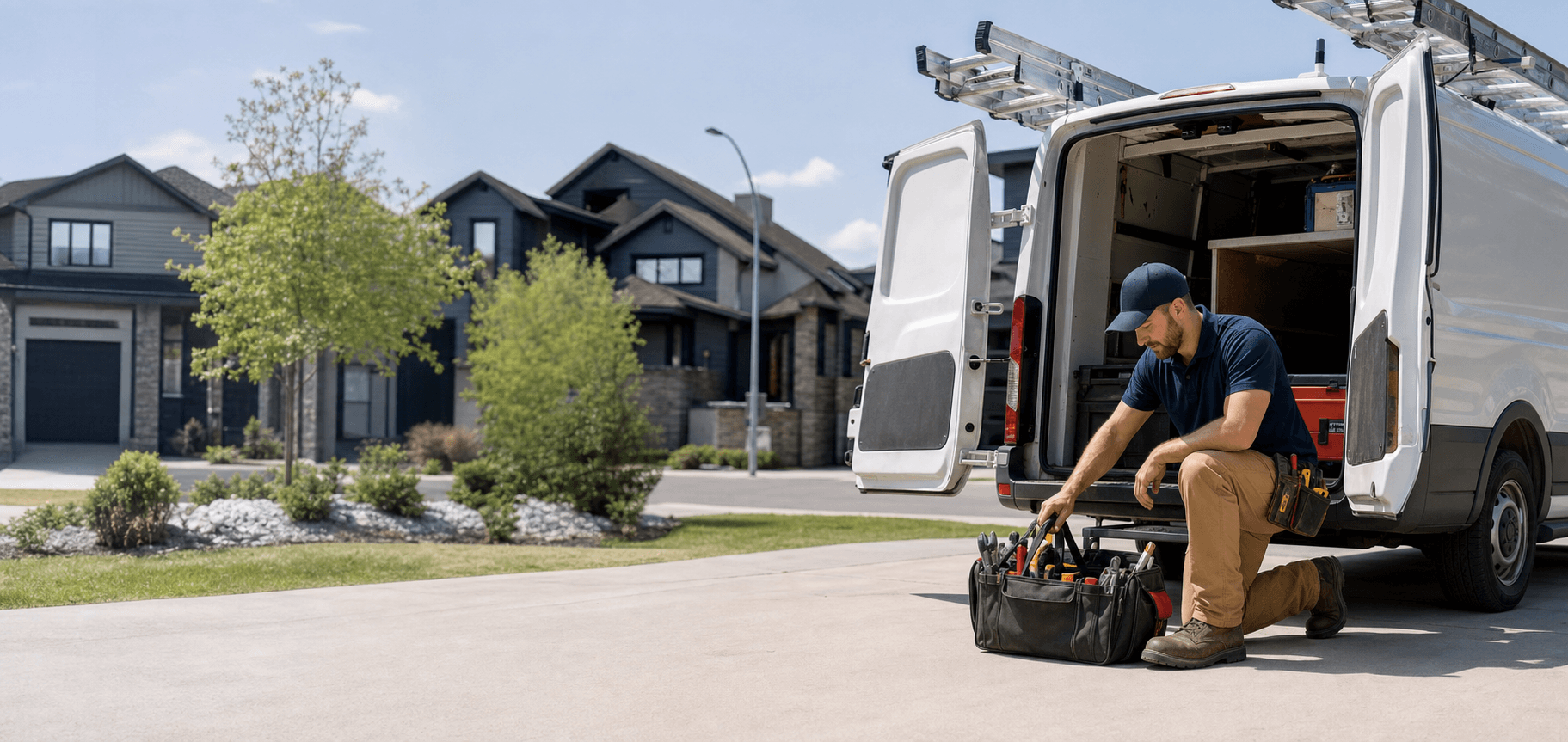
Calgary garages present a unique combination of installation challenges: concrete slab floors that experience significant thermal cycling, walls built with OSB rather than drywall in many detached garages, temperature swings from -40°C in January to +35°C in a Chinook July, and occasional frost heave on older slabs. Getting shelving to stay put means choosing fasteners that handle those conditions — not just what holds on install day.
Understanding Calgary garage construction
Calgary attached garages (part of the main house structure) are typically framed with wood studs at 16 inches OC, drywalled on the interior side, with an insulated wall. The drywall is standard 1/2-inch, and studs are accessible with a normal stud finder.
Detached garages — especially those built before 2000 — are a different story. Common construction is:
- 2×4 or 2×6 wood studs at 24 inches OC (not 16)
- 7/16-inch OSB sheathing as the interior wall surface (no drywall)
- Uninsulated or poorly insulated walls
- 4-inch unreinforced concrete slab on gravel, with expansion joint at perimeter
- No moisture barrier under slab (pre-1990 construction particularly)
Newer detached garages (post-2010) are more likely to be drywalled and insulated to meet Calgary's energy code, but OSB-interior garages remain common in established neighbourhoods.
Concrete anchor types for Calgary conditions
Choosing the wrong anchor for a concrete garage slab is the most common shelving failure Steve sees. Here is a comparison of anchor types by performance in Calgary's thermal environment:
| Anchor type | How it holds | Pull-out strength (3/16") | Calgary suitability | Removable? |
|---|---|---|---|---|
| Tapcon screw | Thread into concrete | ~1,100 lb in 3,000 PSI concrete | Excellent — unaffected by thermal cycling | Yes |
| Wedge anchor | Wedge expansion against hole wall | ~2,500 lb (1/4" x 1-3/4") | Excellent for heavy loads; permanent | No |
| Sleeve anchor | Expansion sleeve grips hole | ~1,800 lb (1/4") | Good; avoid in cracked or thin concrete | No |
| Drop-in anchor | Set tool expands sleeve | ~1,200 lb (1/4") | Good; flush-mount applications | No |
| Plastic expansion plug | Friction in hole | 150–400 lb (unpredictable) | Poor — thermal cycling loosens friction fit | Sort of |
| Hammer-set anchor | Friction on set | 400–600 lb | Marginal — thermal loosening risk | No |
For most Calgary garage shelving that will be reorganized over time, Tapcon screws are the right answer. They thread into concrete like a screw into wood, can be removed and re-set in the same hole (once — a new hole is needed for a third installation at the same location), and are not affected by Calgary's thermal cycling because the hold is mechanical, not friction.
For permanently mounted heavy-duty shelving — overhead platforms, wall-mounted systems holding 200+ pounds — wedge anchors provide substantially higher pull-out resistance and should be used in those applications.
Finding studs in OSB garage walls
OSB sheathing confuses most electronic stud finders — the inconsistent density of the OSB laminations triggers false positives across the entire surface. Here is the method that works:
- Look for the factory nail or staple line. When OSB is installed, it is fastened to each stud with a nail or staple approximately every 6–8 inches. These fasteners leave a visible depression or small rust spot when viewed in raking light (a flashlight held at a low angle to the surface reveals them). A vertical line of these marks = stud location.
- Probe with a finish nail. At the likely stud location, drive a 2-inch finish nail at a 45° angle. If you hit framing within the first 1 inch, you are on a stud. If the nail goes in freely to 1.5–2 inches before hitting resistance, you have hit the wall cavity. Probe 1 inch to each side to confirm the stud width (~1.5 inches for 2×4 framing).
- Mark and measure. Once you have confirmed one stud, measure 16 or 24 inches to each side (Calgary garages use both spacings). Confirm at the second location with a probe nail before committing.
A magnet stud finder works reliably on OSB walls if the fasteners used were steel nails rather than staples — the magnet finds the nail head. This is the most reliable method for OSB and costs $8–$15 at any hardware store.
Fastener selection for OSB and wood stud walls
For wood stud framing, the fastener choice depends on load:
| Application | Fastener | Size | Notes |
|---|---|---|---|
| Light shelf bracket (under 50 lb per bracket) | Coarse-thread drywall/wood screw | #10 × 3-inch | Into stud; quick, sufficient for light loads |
| Medium bracket (50–100 lb) | Structural screw (GRK, Spax) | #10 × 3-inch or 3.5-inch | Higher shear and pull-out than drywall screw |
| Heavy bracket (100–200 lb) | Lag bolt with washer | 5/16" × 3" lag | Pre-drill pilot hole; use impact wrench or breaker bar |
| Wall track system (over 200 lb total) | Lag bolts into every stud | 5/16" × 3.5" lag | Add blocking between studs if loads concentrate |
| Steel stud framing | Self-drilling TEK screw | #12 × 1-inch TEK | Reduce load expectations — steel stud shear is lower |
OSB provides reasonable shear strength but low withdrawal strength (screws pulling out perpendicular to the surface). For any heavy shelving, screws should always go through OSB and into the stud behind it, not terminate in the OSB panel. The 3-inch minimum screw length ensures at least 1.5 inches of penetration into the stud after passing through OSB.
Shelving options and their trade-offs in a Calgary garage
| System type | Best for | Installation | Calgary winter consideration |
|---|---|---|---|
| Freestanding metal bolt-together (Gladiator, Husky) | Heavy items; easy reconfigure | No wall anchoring needed; tip-anchor optional | Temperature does not affect; check feet on cold slab |
| Wall-mounted track (Rubbermaid FastTrack, Elfa) | Flexible configuration; clear floor | Track screwed to studs; brackets hang on track | Excellent — structural integrity at all temps |
| Fixed shelf brackets with MDF/plywood shelves | Custom depth/length; lower cost | Lag bolts into studs per bracket | Good; MDF swells in humid spring, prefer plywood |
| Ceiling-mounted overhead platform | Seasonal item storage above cars | Lag into ceiling joists — mandatory | Excellent — no temperature concerns at ceiling |
| Wire shelf (ClosetMaid, chrome wire) | Lightweight items; air circulation | Wall anchors or track | Wire clips can become brittle at -30°C; use steel-clip versions |
In Calgary garages that reach -40°C, avoid polypropylene and nylon shelf clips — they become brittle and can fracture. Steel hardware throughout is the correct choice for any unheated or minimally heated garage.
Temperature effects on fasteners and materials
A Calgary garage swings from as cold as -40°C (rare but possible) in winter to +35°C on a Chinook summer afternoon — a 75°C range. That thermal cycling affects:
- Concrete anchors: Tapcons, wedge anchors, and sleeve anchors maintain their mechanical hold through thermal cycling. Plastic expansion plugs lose their friction grip as the concrete and plastic expand and contract at different rates.
- Adhesive products: Construction adhesive as a primary fastening method in a Calgary garage is not appropriate. Adhesive bond strength drops significantly below -20°C, and thermal cycling fatigues the bond at the adhesive-substrate interface. Use adhesive only as a supplement to mechanical fasteners.
- Shelf materials: Plywood is dimensionally stable across the temperature range; MDF expands significantly with the spring humidity increase and is not recommended for garage shelves. Melamine-faced MDF swells at exposed edges. 3/4-inch plywood (ideally ACX or better) is the correct shelf substrate for a Calgary garage.
- Wall plugs for drywall: Plastic toggle bolts (butterfly toggles) work adequately in an insulated, climate-controlled attached garage where temperatures stay above -5°C. In an unheated detached garage, polypropylene toggles can shatter when struck during installation in winter. Metal toggles or Zip-It anchors are more reliable in cold.
Typical garage shelving installation costs in Calgary (2026)
| Project | Typical labour cost | Notes |
|---|---|---|
| Assemble and tip-anchor 2–3 freestanding units | $150–$250 | Customer-supplied shelves; labour only |
| Install wall-mounted track system (8–12 ft) | $200–$350 | Includes stud layout and level; customer supplies hardware |
| Install 3–4 fixed shelf brackets with plywood shelves | $250–$400 | Includes cut-to-size and fastening |
| Overhead ceiling storage platform (4×8) | $300–$500 | Joist location, hardware, installation |
| Full garage storage layout (mixed systems) | $600–$1,000 | Full day; Steve brings anchor kit for all wall types |
Photos of your garage walls — showing the wall finish, any existing shelving or hooks, and the items you need to store — allow Steve to quote accurately before arriving. Most Calgary garage storage projects are completed in 3–6 hours.
Frequently asked questions
What type of anchor should I use for garage shelving on a Calgary concrete slab?
Tapcon screws are the standard for adjustable shelving — they thread into concrete, handle thermal cycling, and are removable. For permanently mounted heavy-load systems, wedge anchors provide higher pull-out strength. Avoid plastic expansion anchors in Calgary garages — they loosen with the -40°C to +35°C thermal cycling.
How do I find studs in a Calgary garage wall for shelf brackets?
For OSB walls, look for the vertical nail/staple lines left by installation, or probe with a finish nail at 1-inch intervals. A magnet stud finder works well if steel nails were used. Once you find one stud, measure 16 or 24 inches to find the next.
How much weight can garage wall shelves hold in a Calgary home?
A standard bracket lag-screwed into a wood stud holds 80–120 lb per bracket. Heavy-duty brackets with 2.5-inch lags can hold 150–250 lb each. Wall-mounted track systems hold 50–75 lb per linear foot. Steel stud walls hold 40–60% less than wood. Specify your heaviest planned load when getting a quote.
Does Calgary cold weather affect garage shelving fasteners?
Yes — plastic expansion plugs lose their friction grip as concrete and plastic expand and contract at different rates through -40°C to +35°C cycles. Tapcon and wedge anchors are mechanical-lock types unaffected by thermal cycling. Check anchors annually by testing for wobble.
Should I buy a freestanding shelving unit or wall-mount shelves in my Calgary garage?
A common hybrid works well: bolt a freestanding unit to the wall at two points (lag into stud or Tapcon into concrete block) — this prevents tip-over without full wall-mount installation. Wall-mounted track systems are best when maximizing floor clearance for vehicles matters most.
Need garage shelving installed in Calgary?
Steve brings the right anchors for concrete slabs and OSB walls, finds studs reliably, and builds storage that stays put through Calgary winters.
Shelf & storage installation service →Get a garage shelving quote →